A complaint — or a post
From the public, a client, law enforcement, or another pilot. The FAA also actively watches social media for drone infractions — a posted video can start a case.
One complaint is all it takes — or one posted video. A neighbor, a client, a passing pilot — and the FAA can open an investigation and ask for your certificate, your registration, and your records. AYNA keeps them current, checked against Part 107, and in one place. You stay in command. We help you stay prepared.

2026: FAA enforcement got teeth
Since January 21, 2026, the FAA has directed its investigators toward legal enforcement — fines and certificate action — when drone operations endanger the public, violate airspace restrictions, or further a crime.
$75,000
Maximum fine per violation for unsafe or unauthorized flights — with or without a pilot certificate.
18
Operations fined $1,771 to $36,770 for violations from 2023 to 2025, announced February 2026.
8
Remote pilot certificate actions in 2025, including a revocation for a restricted-airspace violation.
Source: FAA newsroom. General guidelines, not legal advice.
How an FAA inquiry starts
From the public, a client, law enforcement, or another pilot. The FAA also actively watches social media for drone infractions — a posted video can start a case.
The letter describes what the FAA is looking into and gives you a window to answer — typically 10 days.
Your certificate, registration, flight logs, waivers, and maintenance records for the flight in question. With AYNA, they're already in one place — so you can pull together what the letter asks for quickly.
Where AYNA helps
No action, compliance action, a fine, or certificate action.
Step 3 is where preparation counts. AYNA is built for it.
General guidelines, not legal advice.
AYNA
The records an FAA inquiry turns on — kept current in AYNA, ready when the letter arrives.
General guidelines, not legal advice.
Track
Certificate number, issue date, and a scan of the front and back.
Completion date, provider, certificate, and when the next one is due.
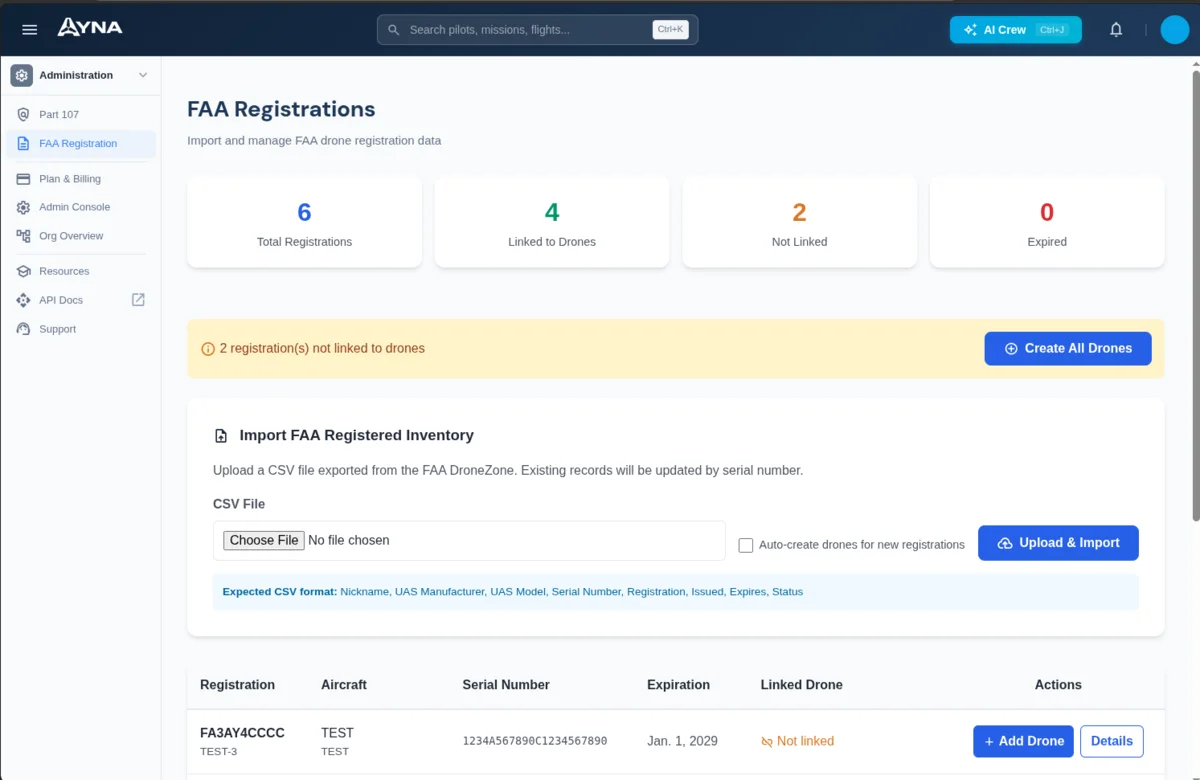
Registration number, serial number, and expiry for every aircraft. Import your FAA registrations from a DroneZone CSV.
Broadcast type and serial for every aircraft that needs one.
Takeoff and landing location, max altitude, operation type, weather, waiver number, and incident notes. Import DJI flight logs.
Work orders, flight hours, and parts replaced.
Kept with the operation they cover.
 FAA Registrations
Check
Each rule carries its federal citation and shows green, amber, or red for every pilot and aircraft. AYNA checks certificates, recurrent training, registrations, markings, Remote ID, and weight from your records — and warns you before anything comes due. The flight-time rules are confirmed by you on the signed pre-flight and post-flight checklists.
Remind
As remote pilot in command, you need to know the rules. AYNA keeps them in view and highlights the Part 107 items that need your attention.
Red and amber items across your pilots and aircraft, and warnings before certificates, recurrent training, and registrations come due.
Each Part 107 and Remote ID rule is shown with its CFR section and how it applies to your operation.
Print the full rulebook or a single rule.
Add company and personal rules, procedures, and checklists alongside the federal ones.
Meet CONCORD
CONCORD is the member of your AYNA crew focused on compliance and readiness. Ask it what Part 107 says, and it reminds you of the rule and highlights what needs attention across your pilots, aircraft, and upcoming flights — it reads your records before it answers. You make the call. Type, or push to talk.
AI can make mistakes — check important details against the regulation. General guidelines, not legal advice.
Things operators ask CONCORD
Part 107 makes the remote pilot in command directly responsible for, and the final authority over, every flight (§107.19). You maintain compliance. AYNA keeps you prepared.
AYNA organizes your records, checks them against Part 107, and reminds you what's due — built from the records you keep and the checklists you complete.
General guidelines, not legal advice.
Straight answers
The letter gives you a window to answer. With your certificate, registration, Remote ID, waivers, flight logs, and maintenance records already in AYNA, you can quickly pull together what the letter asks about for the flight in question. General guidelines, not legal advice.
Yes. Investigations often start with a complaint from the public, a client, or law enforcement. The FAA also watches social media, so a posted video can start a case. Solo operators are included, and fines can apply with or without a pilot certificate.
AYNA checks your remote pilot certificate, recurrent training, aircraft registration, registration marking, Remote ID, and weight from your records, and warns you before they come due. Flight-time rules — daylight, visibility, line of sight, altitude, airspace authorization — are confirmed by you on the signed pre-flight and post-flight checklists.
Waivers live in your compliance records, and each flight keeps its waiver number. Your pre-flight checklist has you confirm airspace authorization and NOTAMs, signed and time-stamped.
Every pilot and every aircraft gets its own status and its own alerts — DJI, ArduPilot, PX4, or any other FAA-registered aircraft.
Yes — starting your records on day one is the easiest way to stay ready. If you're also looking for your first paying client, see the first-client path; it's the same AYNA workspace.
Yes, a card is required to start, but $0 is charged today. You're charged only if you continue after 14 days, and you can cancel anytime.
Ready when the FAA asks
Put your certificates, aircraft, flights, and checklists in one place — checked against Part 107, every day.